
The telehealth industry has shifted from a convenient alternative to an essential pillar of healthcare delivery. With the US telehealth market projected to reach $185.6 billion by 2026, healthcare organizations face a critical decision: choosing the right development partner to build secure, compliant, user-friendly telehealth solutions.
This guide compares the top telehealth app development companies in the USA — with the credibility signals, specializations, and selection criteria you need to choose a vendor that fits your clinical objectives, regulatory requirements, and patient-experience goals.
Already scoping a build? Book a free 30-minute consultation with our healthcare team, or jump to cost considerations for current pricing ranges.
How We Compared These Companies
The firms below were evaluated on the factors that actually predict telehealth project success:
- Healthcare specialization — exclusive or deep healthcare focus vs. healthcare as one vertical among many.
- Regulatory compliance — demonstrated HIPAA (and where relevant HITRUST, SOC 2, GDPR, FDA) expertise.
- Interoperability — proven HL7/FHIR integration with Epic, Cerner-Oracle, Allscripts, athenahealth.
- Credibility signals — years in healthcare, project counts, third-party recognition (Clutch, ISO, awards).
- Engagement fit — startup MVP vs. enterprise health-system rollout.
Top Telehealth App Development Companies in the USA
1. Taction Software — Healthcare-Specialized, HIPAA-Native
Overview: With 20+ years dedicated exclusively to healthcare technology and 785+ healthcare clients, Taction Software is a healthcare-specialist telehealth app development partner — not a generalist agency with a healthcare side practice.
Why it stands out:
- HIPAA-native development. Every project starts with HIPAA as foundational architecture, not a retrofit, via a proven HIPAA-compliant software development framework — with zero HIPAA findings on shipped software.
- Deep EHR integration. Certified Mirth Connect developers and 200+ EHR integrations using HL7 v2.x, CDA, and FHIR, connecting telehealth platforms to Epic, Cerner-Oracle, Allscripts, labs, pharmacies, and imaging.
- Proprietary TURBO framework. Accelerates delivery ~40% while maintaining quality, with healthcare-specific modules for scheduling, clinical documentation, e-prescribing, and remote monitoring.
- Specialty breadth. From telemedicine app development to specialty builds like physiotherapy apps, cardiology, behavioral health, and chronic-disease management.
- Enterprise SaaS. HIPAA SaaS app development with white-label, multi-tenant architecture for health systems launching branded telehealth fast.
Best for: Healthcare organizations that want deep clinical knowledge, embedded HIPAA expertise, and complex EHR integration handled correctly the first time.
Talk to Taction: Get a free consultation → We’ll scope your telehealth build, timeline, and a transparent estimate.
2. Glorium Technologies
Glorium earned the #1 spot on Clutch’s Top Healthcare Custom Software Development Companies list and has received 80+ industry awards. Its telemedicine work integrates remote patient monitoring and IoMT with HIPAA/HITRUST certification. Best for: healthtech startups and growth-stage companies wanting an award-recognized, certified partner.
3. DataArt
A large, established firm (5,000+ consultants and engineers) offering full-cycle telemedicine software development, including compliance verification and validation, remote patient monitoring, and virtual clinical-trial solutions. Best for: enterprise-scale builds needing substantial delivery capacity and validation rigor.
4. Orangesoft
A full-cycle telemedicine software company with 300+ projects delivered and 15+ years in healthcare software, spanning telemedicine platforms, remote patient monitoring systems, software for medical devices, and other regulated healthcare tools.
Why it stands out:
Expertise. Orangesoft creates secure, compliant, and accessible software solutions tailored to the unique challenges, interoperability requirements, and regulatory context of the healthcare industry.
Proven tech stacks: The company has over 15 years of experience in developing custom solutions based on modern technologies, frameworks, and cloud infrastructures tailored to healthcare needs.
Strong compliance and security: The company’s solutions are developed in line with ISO 13485 and IEC 62304 standards, and meet the requirements of applicable healthcare regulations, whether it’s HIPAA, FDA, EU MDR, or GDPR.
Well-established reputation: Orangesoft has delivered over 300 web and mobile projects via a mature and calibrated delivery process.
Best for: mid-market organizations wanting a proven, healthcare-focused delivery track record.
5. Cleveroad
An ISO-certified healthcare software development company handling full project ownership from discovery through maintenance, with HIPAA-compliant telemedicine, EHR/EMR, and custom healthcare solutions. Best for: organizations prioritizing certified process maturity and end-to-end ownership.
6. Intellias
Builds telehealth solutions engineered to be secure, scalable, and interoperable, in compliance with HIPAA, GDPR, CCPA, PIPEDA, and FDA. Best for: companies with multi-jurisdiction compliance needs (US + international).
7. TechMagic
10+ years of telemedicine development experience and recognized by Clutch as a top healthtech developer, with strength in custom telehealth products and AI/ML integration. Best for: product teams wanting modern engineering and AI-enabled features.
8. Innowise
A full-cycle software firm with 18+ years of experience and 60+ delivered healthcare IT solutions, including native iOS/Android apps and EHR/EMR platforms. Best for: large, complex builds needing broad engineering depth.
Other reputable healthcare/telehealth developers worth shortlisting include Binary Studio, Arkenea, Cleveroad, Relevant Software, and Yalantis. Always validate current capabilities, healthcare references, and certifications directly — vendor capabilities change quickly.
Quick Comparison
| Company | Healthcare focus | Standout credibility signal | Best for |
|---|---|---|---|
| Taction Software | Exclusive, 20+ yrs | 785+ clients, 200+ EHR integrations, zero HIPAA findings | Complex EHR integration, HIPAA-native builds |
| Glorium Technologies | Strong | #1 Clutch healthcare list, 80+ awards, HITRUST | Startups, certified partner |
| DataArt | Strong | 5,000+ experts, compliance V&V | Enterprise-scale capacity |
| Orangesoft | Strong | 300+ projects, 15+ yrs | Mid-market track record |
| Cleveroad | Strong | ISO-certified, full ownership | Process maturity |
| Intellias | Strong | HIPAA + GDPR/CCPA/PIPEDA/FDA | Multi-jurisdiction compliance |
| TechMagic | Strong | 10+ yrs, Clutch top healthtech | AI/ML-enabled products |
| Innowise | Broad | 18+ yrs, 60+ healthcare solutions | Large, complex builds |
Where Taction fits: if your project hinges on getting HIPAA and EHR integration right — the two areas where telehealth builds most often fail — that’s our deepest specialization. Start with a free scoping call →
Critical Selection Criteria for Telehealth Development Partners
Regulatory compliance expertise. HIPAA isn’t optional — it’s foundational. Leading HIPAA-compliant app development companies in the USA understand technical safeguards, administrative controls, BAAs, audit logging, breach-notification protocols, and security risk assessments — well beyond basic encryption.
Healthcare interoperability experience. Telehealth must communicate with existing IT infrastructure. Look for proficiency with HL7, FHIR, and integration with Epic, Cerner-Oracle, and Allscripts — the hallmark of serious mHealth app development.
Clinical workflow understanding. Technical capability alone doesn’t guarantee clinical utility. The best partners understand provider workflows, patient-engagement patterns, and care-delivery models that drive intuitive design.
Security architecture. Beyond HIPAA baselines: end-to-end encryption, secure authentication, role-based access controls, and comprehensive audit trails.
Essential Features in Modern Telehealth Applications
Core clinical functionality: HD video consultation with screen sharing, asynchronous messaging, digital stethoscope/exam-camera integration, e-prescribing with pharmacy connectivity, clinical documentation with voice-to-text, and calendar-synced scheduling.
Patient engagement: Secure patient portals with record access, medication reminders and adherence tracking, education libraries, symptom checkers, and caregiver/family access.
Remote patient monitoring: Integration with blood-pressure monitors, glucometers, and pulse oximeters; continuous vital-sign monitoring with automated alerts; trend dashboards; and care-plan goal tracking.
Administrative: Multi-provider scheduling, insurance verification/eligibility, payment processing with co-pay collection, billing and claims, and quality-metric analytics.
Security and compliance: End-to-end AES-256 encryption, multi-factor authentication, role-based access, comprehensive audit logging, automatic session timeouts, secure backup/recovery, and BAAs with all subcontractors.
The Development Process: What to Expect
Discovery and planning (2–4 weeks): Stakeholder interviews, clinical-workflow analysis, technical architecture, compliance assessment, roadmap.
Design (3–6 weeks): UX research with patients and providers, wireframing/prototyping, brand integration, WCAG 2.1 accessibility, usability testing.
Development sprints (12–20 weeks): Iterative 2-week sprints, continuous integration/testing, regular demos, scope refinement, parallel web + mobile.
Security and compliance review (2–4 weeks): Penetration testing, HIPAA Security Rule verification, third-party audits, remediation.
Integration and testing (4–6 weeks): EHR integration, payment gateways, pharmacy/lab connections, end-to-end and load testing.
Deployment and training (2–3 weeks): Production setup, provider training, patient onboarding, go-live support, post-launch monitoring.
You can engage HIPAA-compliant app developers for hire to augment internal teams for specific phases, or for complete turnkey delivery.
<a id=”cost”></a>
Cost Considerations and Pricing Models
Basic telemedicine platform: $75,000–$150,000 — essential video consultation, simple scheduling, basic patient management.
Comprehensive telehealth solution: $200,000–$500,000 — full-featured with EHR integration, remote monitoring, prescription management, and advanced analytics.
Enterprise telehealth ecosystem: $500,000+ — health-system-wide, multi-specialty, complex integration, custom clinical modules, white-label.
Engagement models: Fixed-price (budget certainty, less flexibility), time-and-materials (adaptable, needs strong PM), dedicated team (best for long roadmaps), or hybrid.
Ongoing costs: Hosting/infrastructure ($2,000–$10,000/month by usage), maintenance/support (15–20% of build cost annually), compliance audits, and feature evolution.
Want a number for your specific scope? Request a free, itemized estimate → — no obligation, typically back within 48 hours.
Key Questions to Ask Prospective Partners
Healthcare experience: How many telehealth platforms have you built? Can you share references from similar organizations? Which specialties? How do you stay current on regulations?
Technical capabilities: Which EHRs have you integrated with? How is HIPAA handled across the lifecycle? What security certifications does your team hold? How do you ensure performance and scalability?
Process: Typical timeline? How are scope changes handled? Testing protocols? How are clinical stakeholders involved?
Post-launch support: Training for staff? Support SLAs and response times? Security-incident handling? Ongoing enhancement approach?
Business: What IP rights do we retain? Payment-milestone structure? What if the project exceeds timeline/budget? Client satisfaction metrics?
Emerging Trends Shaping Telehealth Development
AI and ML: Intelligent triage, predictive analytics for deterioration, automated clinical documentation, diagnostic decision support.
Expanded remote monitoring: Wearables, continuous glucose monitoring, cardiac rhythm analysis, smart-packaging adherence tracking.
Behavioral health: Growing demand for telepsychiatry, crisis-intervention integration, session analysis, outcome measurement.
Social determinants of health: Social-needs screening, community-resource directories, transportation and food-insecurity coordination.
Value-based care: Quality-metric tracking, care-gap identification, engagement measurement, population-health tools.
Making Your Selection Decision
Choosing the right telehealth development partner means balancing specialized healthcare expertise, proven compliance, technical capability, cultural fit, budget, and long-term partnership potential. Request detailed proposals from 3–5 qualified vendors, check references with similar healthcare clients, review architecture documentation, and evaluate post-launch support — not just initial delivery price.
For organizations prioritizing specialized expertise, Taction Software’s distinguishing strengths are exclusive healthcare focus over two decades, HIPAA compliance embedded in every phase, 200+ EHR integrations, proprietary delivery frameworks, and transparent pricing. With 785+ deployed healthcare applications, it’s positioned for organizations that want telehealth platforms balancing clinical excellence, technical depth, and regulatory compliance.
Ready to start? Book your free consultation → or explore Taction’s telehealth app development services.
Frequently Asked Questions
Who are the best telehealth app development companies in the USA? Leading healthcare-focused developers include Taction Software (20+ years healthcare-only, 785+ clients, deep HIPAA/EHR expertise), Glorium Technologies (#1 on Clutch’s healthcare list, HITRUST-certified), DataArt, Orangesoft, Cleveroad (ISO-certified), Intellias, TechMagic, and Innowise. The best fit depends on your scale, specialty, compliance needs, and budget — a startup MVP and an enterprise health-system rollout call for different partners.
What is the most important factor when selecting a telehealth development company? Healthcare-specific expertise. Telehealth requires deep understanding of clinical workflows, regulatory compliance, interoperability standards, and patient-safety considerations that generic software companies lack. Prioritize vendors with HIPAA-compliant portfolios, healthcare references, and relevant certifications over the lowest cost or fastest timeline.
How long does it take to develop a custom telehealth application? A basic telemedicine platform typically takes 4–6 months; comprehensive solutions with EHR integration and remote monitoring 6–12 months; and enterprise multi-specialty implementations 12–18 months. Proprietary frameworks (like Taction’s TURBO) can accelerate timelines 30–40% while maintaining quality and compliance.
How much does HIPAA-compliant telehealth app development cost? HIPAA compliance adds roughly 15–25% to baseline costs (security architecture, encryption, audit logging, documentation, testing). Basic HIPAA-compliant platforms run $75,000–$150,000, comprehensive solutions $200,000–$500,000, and enterprise builds $500,000+. Building compliance in from the start is cheaper than retrofitting a non-compliant app — and avoids penalties that can reach $1.5M per violation category annually.
Can a new telehealth app integrate with our existing EHR? Yes. Modern telehealth platforms integrate with Epic, Cerner-Oracle, Allscripts, and Meditech via HL7 and FHIR, enabling bidirectional data exchange — auto-documenting encounters in the chart, retrieving history during consults, syncing schedules, and updating medication lists. Firms with certified integration specialists and Mirth Connect developers (like Taction) handle the technical complexity reliably and compliantly.
What ongoing maintenance should we expect after launch? Technical maintenance (hosting, security patches, bug fixes, API updates), compliance maintenance (annual security assessments, HIPAA documentation, regulatory updates, audit support), and feature evolution. Budget ~15–20% of initial build cost annually. Look for tiered support with defined SLAs and proactive monitoring.
Can telehealth platforms support multiple clinical specialties? Yes. Configurable workflows support primary care, urgent care, behavioral health, cardiology, dermatology, rehabilitation, and more — with specialty-specific templates, decision support, device integrations, and workflow variations. Choose a partner experienced across specialties so the platform can expand without re-engineering.
What security measures are essential for telehealth apps? Layered protection: end-to-end AES-256 encryption, TLS 1.2+ in transit, multi-factor authentication, role-based access, automatic session timeouts, comprehensive audit logging, encrypted storage, secure backup/disaster recovery, regular penetration testing, and BAAs with all providers — often plus biometric auth, device management, and anomaly detection.
What happens if our telehealth vendor goes out of business? Mitigate this in the contract: source-code escrow, clear IP ownership, data portability, and transition assistance. Also assess vendor financial stability, client retention, and track record. Established firms with long healthcare histories and diverse client bases (e.g., Taction’s 20 years and 785+ clients) present lower discontinuation risk than newer startups.
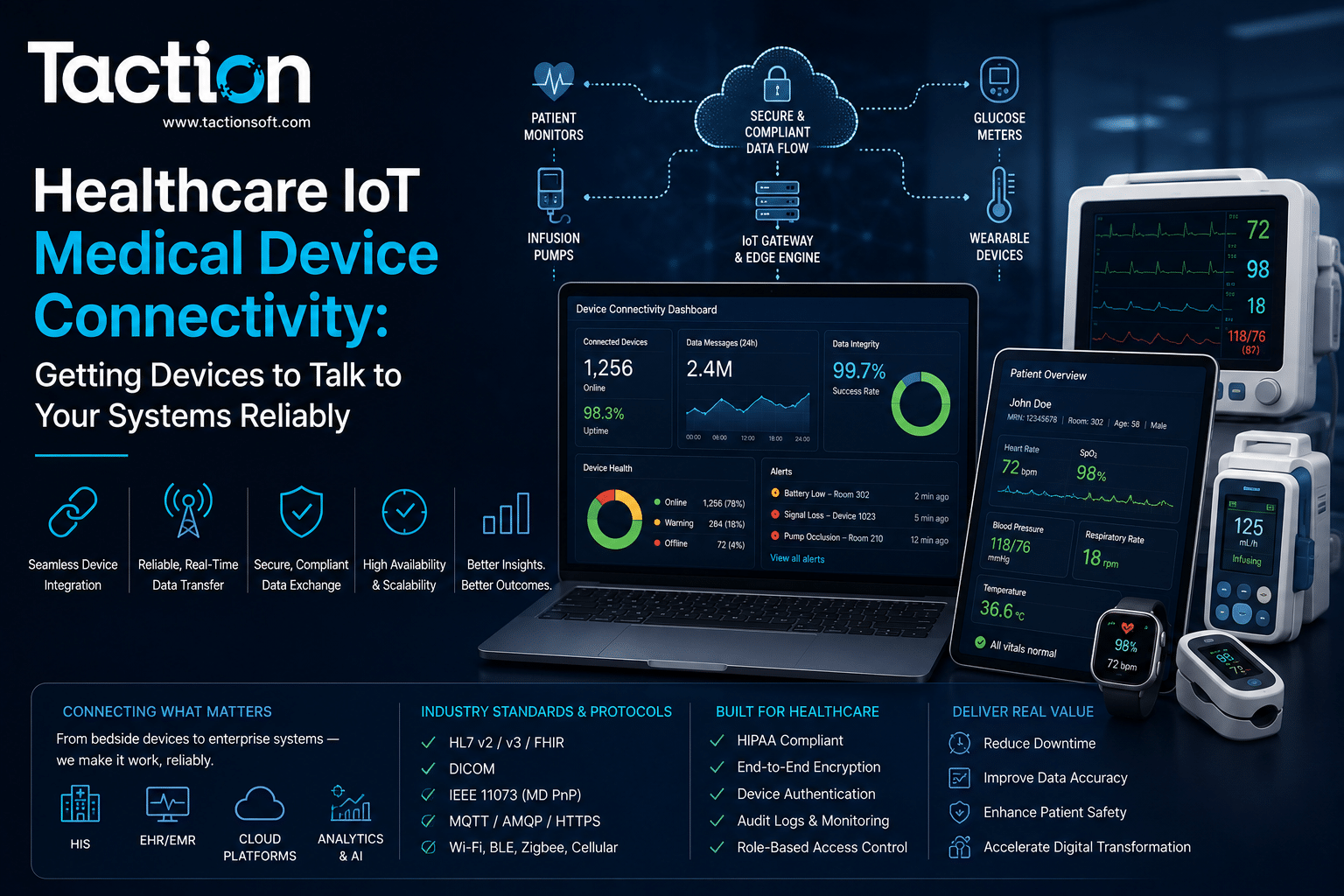
Can telehealth platforms incorporate remote patient monitoring devices? Yes — via Bluetooth devices (BP monitors, pulse oximeters, glucometers, scales), FDA-cleared wearables (continuous glucose and cardiac monitors), and clinical-grade devices (smart inhalers, spirometers), enabling automated vital-sign collection, real-time abnormal-reading alerts, trend analysis, and data-driven care-plan adjustments.